
فئات
بلوق جديد
Why Are Ball Bearing Exhaust Fans More Reliable for Continuous Cooling in Air Purifiers and Aroma Diffusers?
September 16 , 2026Modern household appliances are becoming smaller, smarter, quieter, and more multifunctional. At the same time, many appliances are expected to operate for long periods without interruption. Air purifiers may run throughout the day and night, aroma diffusers may operate for several hours at a time, and compact electronic appliances may continuously generate heat inside a limited enclosure.
These trends create a growing demand for compact cooling fans that can provide stable airflow while maintaining low noise, low power consumption, and reliable long-term operation.
Among the many fan technologies available, ball bearing exhaust fans are often considered when continuous operation and elevated internal temperatures become important design requirements. The reason is not simply that a ball bearing is mechanically stronger. The complete bearing system, lubrication method, motor design, fan structure, operating temperature, airflow resistance, and installation conditions all contribute to the final service life.
For appliance manufacturers, selecting the right small cooling fan is therefore not just a question of choosing the smallest available model. It requires understanding how the fan will behave after thousands of hours of operation.
This article explains why ball bearing fans can provide advantages in continuous cooling applications, how high temperature affects fan reliability, and why appliances such as air purifiers and aroma diffusers require careful fan selection.
Why Continuous Operation Changes Fan Selection
A fan used for several minutes does not face the same requirements as a fan expected to operate continuously.
During short-term operation, a small amount of bearing wear or heat accumulation may have little practical effect. However, when the fan operates for thousands of hours, even small mechanical or thermal stresses can accumulate.
The bearing rotates continuously around the motor shaft. The motor generates heat. The housing transfers heat into surrounding components. Dust and airflow resistance may change over time. The internal temperature of the appliance may also become higher than the surrounding room.
These factors make long-term reliability especially important.
In a household appliance, fan failure may create more than an airflow problem. A failed cooling fan can increase internal temperature, affect electronic components, reduce appliance performance, or cause protective shutdowns.
This is why fan reliability should be evaluated as part of the complete appliance system rather than as an isolated component.
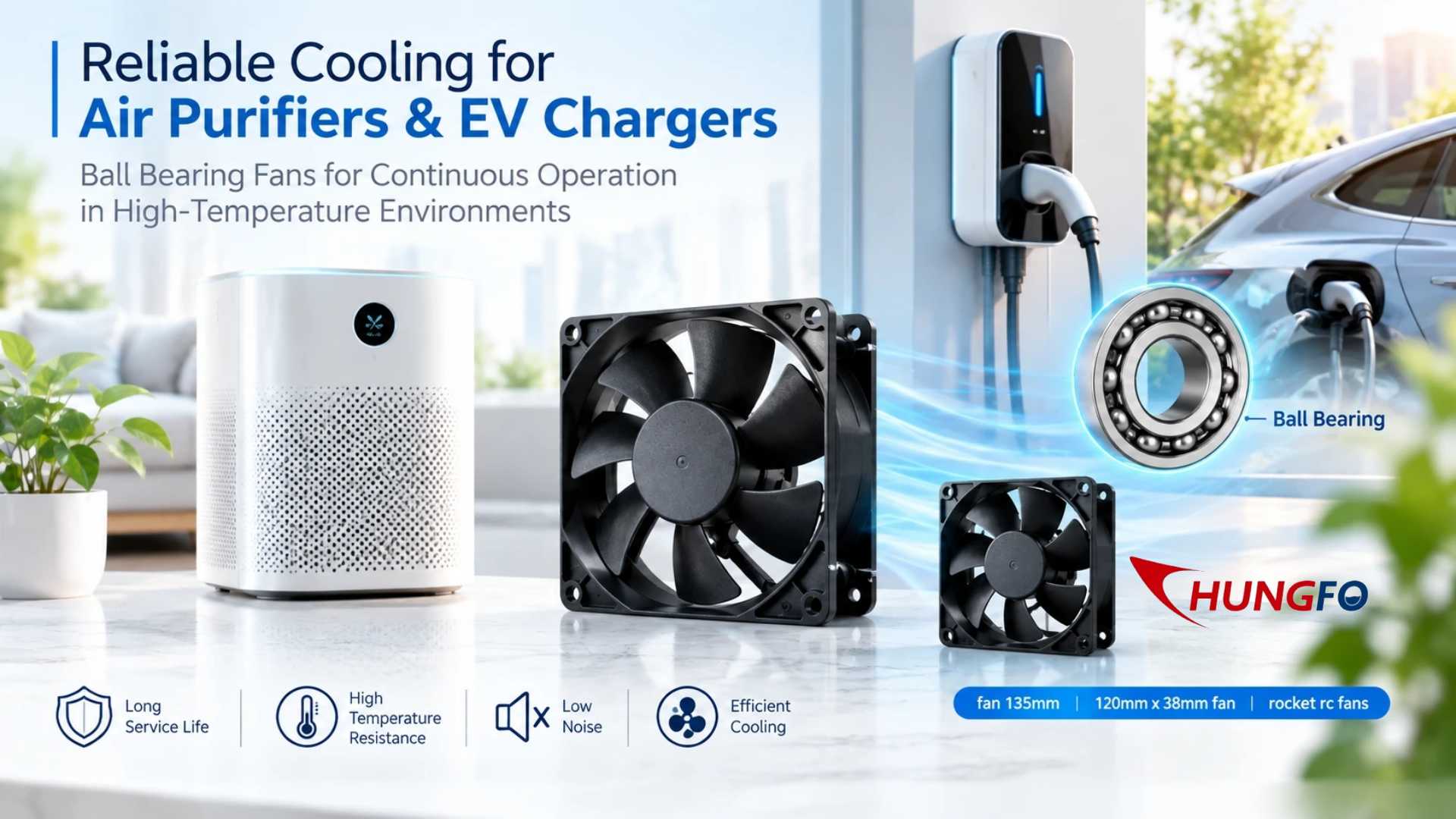
Bearing Design Is One of the Most Important Reliability Factors
The bearing supports the rotating shaft and allows the impeller or rotor to rotate smoothly. Because the fan motor operates continuously, the bearing is exposed to repeated rotation, friction, temperature changes, and lubrication stress.
Fan manufacturers commonly use sleeve bearings, ball bearings, hydraulic bearings, fluid dynamic bearings, and other bearing structures.
Each technology has different advantages.
Sleeve bearings can provide economical solutions and can be suitable for many moderate operating environments. However, their long-term performance can be affected by lubrication deterioration and temperature.
Ball bearings use rolling elements between bearing races. This structure reduces sliding friction and can provide stable shaft support over a long operating period.
According to technical information from fan and thermal-management sources, bearing deterioration is one of the major causes of fan failure, and temperature can significantly influence bearing and lubricant life. Ball bearing systems are widely used when long operating life and higher temperature capability are important design considerations.
For this reason, a ball bearing exhaust fan can be an appropriate solution when a compact appliance needs continuous airflow under demanding thermal conditions.
Why High Temperature Matters
Temperature is one of the most important factors affecting fan service life.
A fan does not simply operate at the room temperature surrounding the appliance. The actual temperature experienced by the bearing and motor may be higher because of internal heat generation.
For example, an air purifier may contain a motor, control board, power supply, sensors, LED components, and filtration elements inside a relatively compact housing. If the airflow path is restricted, heat may accumulate around the motor and electronics.
An aroma diffuser can have a similarly compact internal structure. Depending on the design, it may contain a control circuit, lighting system, pump, heating element, communication module, or other electronics.
The fan therefore needs to operate in the actual thermal environment rather than an ideal laboratory environment.
High temperature can accelerate lubricant degradation. As lubrication deteriorates, friction can increase. Increased friction can produce more heat and noise, which may further accelerate wear.
Technical guidance from Oriental Motor explains that cooling-fan life is strongly related to deterioration of bearing grease and that grease life depends significantly on temperature and rotational conditions.
This explains why thermal design and bearing selection should be considered together.
Ball Bearings and Continuous High-Temperature Operation
Ball bearings are not automatically suitable for every high-temperature application. The specific bearing construction, grease, sealing system, motor insulation, plastic materials, and rated operating temperature all matter.
However, compared with basic sleeve-bearing structures, ball bearings can offer important advantages in many continuous-duty applications.
One advantage is their rolling contact structure.
Instead of relying primarily on a sliding surface and lubrication film, the rolling elements transfer the rotational movement between the bearing races. This can reduce certain forms of friction and provide stable shaft support.
Another advantage is installation flexibility.
Depending on the bearing design, ball bearing fans are generally less sensitive to mounting orientation than traditional sleeve-bearing fans. This can be useful when a household appliance has limited installation options.
A third advantage is long-term mechanical stability.
A compact appliance may experience repeated starts and stops. The fan may operate at different speeds depending on temperature, user settings, or control algorithms. A well-designed ball bearing system can support this type of repeated operation.
DigiKey and Eaton both identify bearing deterioration as a key factor in fan life and discuss the advantages of ball bearing systems for demanding continuous-operation conditions.
However, the final fan selection should always be based on the manufacturer's actual specifications rather than assuming that every ball bearing fan has the same service life.
Why Air Purifiers Need Reliable Small Fans
Air purifiers are one of the most important applications for compact fan technology.
The basic principle is straightforward. The fan pulls room air into the appliance, pushes it through one or more filtration stages, and releases treated air back into the room.
However, filters create airflow resistance.
As a filter becomes denser or accumulates particles, the pressure required to maintain airflow can change. This means the fan needs not only sufficient airflow but also appropriate static pressure.
If the fan cannot overcome the resistance, airflow may decrease.
If the fan operates at an unnecessarily high speed, noise and power consumption may increase.
Therefore, fan selection should consider the complete pressure-flow relationship rather than relying only on the fan's free-air airflow rating.
This is especially important for compact residential air purifiers because the available installation space is limited.
A small centrifugal blower may be appropriate when higher static pressure is needed. A compact axial fan may be more suitable when the airflow path has relatively low resistance.
The bearing system then becomes an additional consideration because the fan may operate for many hours every day.
For an appliance designed to operate during sleeping hours, noise is equally important.
A fan that produces excessive bearing noise may reduce the perceived quality of the entire appliance even if its airflow performance is technically acceptable.
Why Aroma Diffusers Also Need Quiet Cooling
Aroma diffusers are another application where compact cooling fans can play an important role.
The purpose of an aroma diffuser is often associated with relaxation, comfort, sleep, or creating a pleasant indoor environment. Therefore, a noisy fan can negatively affect the user's experience.
Modern aroma devices may contain electronic controls, LEDs, sensors, pumps, heating components, wireless communication modules, or other electrical systems.
These components can generate heat.
When the internal enclosure is small, natural convection may not be sufficient to remove heat efficiently.
A miniature cooling fan can create controlled airflow and help move heat away from sensitive components.
However, the fan should not become the loudest component in the appliance.
This is where bearing quality, motor balancing, blade geometry, housing design, and speed control become important.
The goal is not simply to produce maximum airflow. The goal is to provide sufficient thermal performance while maintaining acceptable acoustic performance.
How Fan Size Influences Appliance Design
Small appliances often have very limited internal space.
A large fan may offer higher airflow, but it may not physically fit into the product.
This creates a design challenge.
Engineers need to determine the available installation area, required airflow, pressure requirement, fan thickness, connector position, voltage, current, operating temperature, and noise target.
Different applications may require completely different fan dimensions.
For example, a compact appliance may use a miniature blower because it needs concentrated airflow through a narrow air channel.
Another product may use a larger axial fan because it has more available space and requires broader airflow.
A 120mm x 38mm fan can be relevant in larger thermal-management applications where airflow and pressure requirements are greater, while smaller fans may be more appropriate for compact consumer products.
The important point is that size should be selected according to system requirements rather than simply choosing the largest fan that fits.
Why Static Pressure Is Important
Many appliance designers initially focus on airflow.
However, airflow alone does not tell the whole story.
A fan's ability to maintain airflow against resistance is equally important.
Filters, ducts, protective grilles, narrow openings, heat exchangers, and internal channels can all create pressure resistance.
An air purifier is a particularly clear example because the filtration system directly influences airflow resistance.
A fan with insufficient pressure capability may provide an impressive free-air airflow number but perform poorly after installation.
Therefore, engineers should examine the fan curve and determine the operating point of the complete system.
This is also why blower fans can be valuable in compact appliances.
Blowers can produce concentrated airflow and are often suitable when air must travel through a restricted passage.
The selection between an axial fan and blower should depend on the airflow path and pressure requirements.
The Relationship Between Fan Speed and Reliability
Higher RPM can increase airflow and pressure, but it can also influence noise, power consumption, vibration, and bearing stress.
For continuous operation, engineers should avoid selecting a fan that must operate permanently at the edge of its performance range.
A better approach is to determine the actual thermal requirement first.
If the appliance requires only moderate airflow, an appropriately sized fan running at a suitable speed may provide a better balance between cooling and acoustic performance.
If the system requires higher pressure, a blower or optimized high-speed fan may be necessary.
This is where application-specific fan design becomes important.
For example, product categories such as rocket rc fans demonstrate that compact high-speed fan designs can be associated with specialized airflow requirements, but such products should not automatically be treated as interchangeable with appliance cooling fans. The motor, bearing, airflow curve, noise target, operating temperature, and control requirements can be completely different.
The same principle applies to a fan 135mm.
The dimensional specification alone does not determine whether the fan is appropriate. Engineers need to evaluate airflow, static pressure, power, RPM, bearing structure, noise, and temperature capability together.
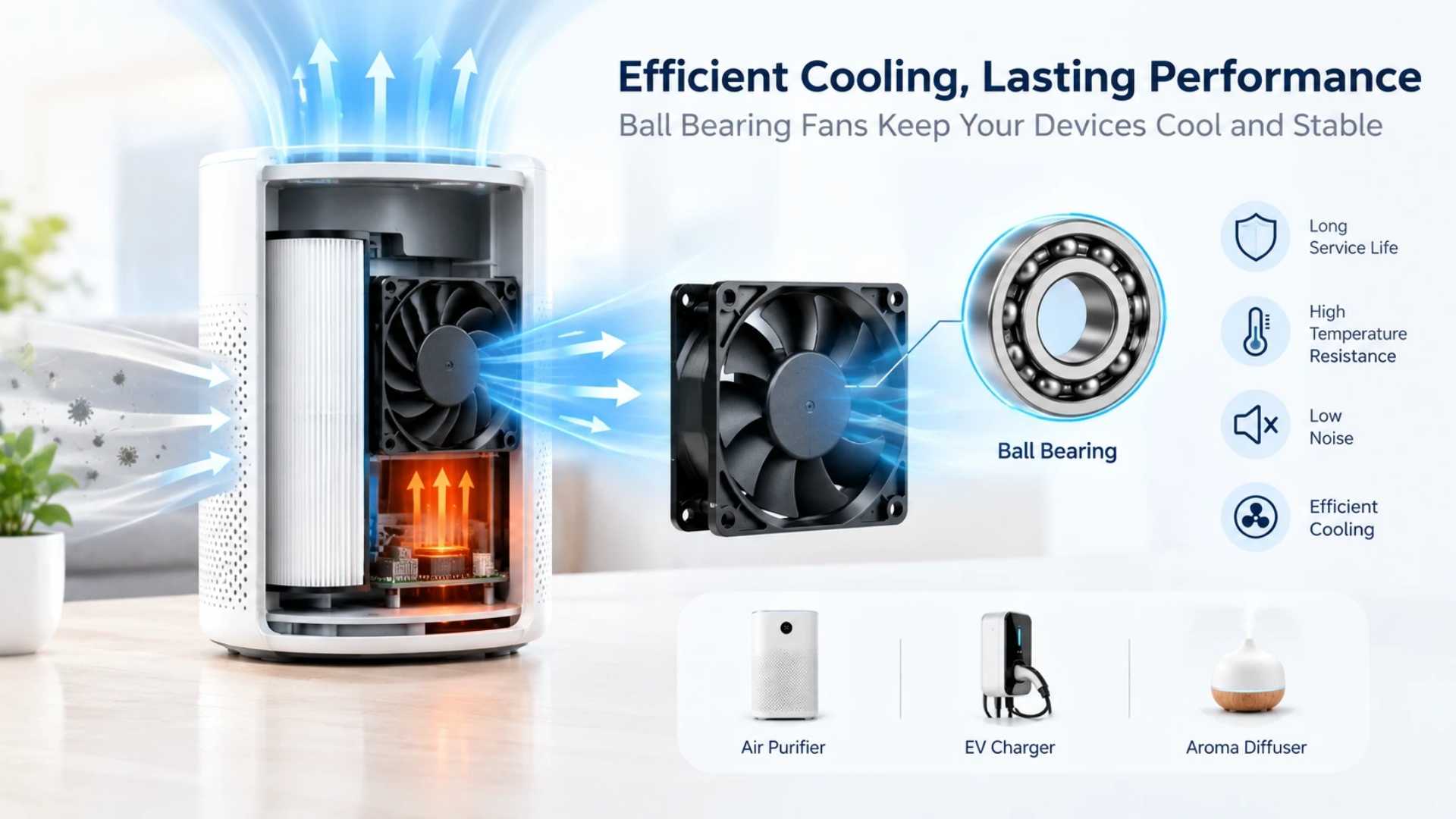
Why Low Noise Matters as Much as Reliability
Reliability and noise are closely connected.
A fan bearing that begins to deteriorate may gradually produce more noise.
The fan may still rotate, but the acoustic performance can become unacceptable before complete failure occurs.
This is particularly important for household appliances.
In an industrial cabinet, a small increase in fan noise may be difficult to notice.
In a bedroom air purifier, however, the same increase can become immediately noticeable.
For this reason, acoustic testing should be included in fan validation.
Manufacturers should examine not only the initial noise level but also whether the sound changes after long-duration operation.
This can provide useful information about bearing wear, rotor balance, structural resonance, and lubrication condition.
Motor Design Also Influences High-Temperature Reliability
The bearing is important, but it is not the only component exposed to heat.
Motor windings, insulation materials, magnets, electronic components, adhesives, and plastic structures also have temperature limits.
If the fan motor continuously operates at a high temperature, the winding insulation must be appropriate for the application.
The fan's electrical design should also prevent unnecessary heat generation.
A high-efficiency motor can reduce electrical losses and therefore reduce self-heating.
This creates a useful chain of reasoning.
Better electrical efficiency can reduce motor heat.
Lower motor heat can reduce the thermal burden on the bearing.
A lower internal temperature can help preserve lubricant performance.
Better thermal conditions can contribute to longer service life.
Therefore, high-temperature reliability is a system-level issue.
Why Manufacturing Quality Matters
Even a theoretically excellent bearing design cannot compensate for poor manufacturing quality.
The rotor must be balanced.
The shaft must be properly aligned.
The bearing must be installed correctly.
The housing must maintain the required tolerances.
The motor winding must be manufactured consistently.
The fan blades must maintain dimensional accuracy.
Quality control is therefore critical.
For continuous-duty fans, manufacturers may perform dynamic balancing, noise testing, high-temperature testing, speed testing, current testing, airflow testing, pressure testing, and endurance testing.
These processes help identify problems before the fan enters the customer's appliance.
For OEM applications, the manufacturer should also maintain consistent production specifications between batches.
Why Dual Ball Bearings Can Be Important
Not all ball bearing systems are identical.
Some fans use a single ball bearing arrangement, while others use dual ball bearings.
For applications requiring long-term continuous operation, the complete bearing architecture should be evaluated.
A dual ball bearing system can provide stable support for the shaft and is commonly selected for applications where long service life and flexible installation are important.
However, bearing type alone should not be treated as a guarantee of lifetime.
Lubricant quality, bearing quality, operating temperature, RPM, sealing, rotor balance, installation stress, and motor temperature all matter.
A professional fan manufacturer should therefore provide application-specific recommendations instead of simply claiming that one bearing type is universally superior.
How to Select a Ball Bearing Exhaust Fan
The first question should be the actual application.
Will the fan cool electronics?
Will it move air through a filter?
Will it remove heat from a motor?
Will it operate continuously?
Will it be installed in a bedroom?
Will it be exposed to elevated temperatures?
The second question should be airflow.
Determine the required airflow under actual system resistance rather than relying only on free-air data.
The third question should be static pressure.
If the airflow path contains filters or narrow channels, pressure capability becomes especially important.
The fourth question should be temperature.
Determine both ambient temperature and the expected internal temperature around the fan.
The fifth question should be noise.
For consumer appliances, the acoustic target should be established early.
The sixth question should be service life.
Manufacturers should specify life data under defined temperature and operating conditions.
L10 life is particularly useful because it describes the expected operating time at which 10 percent of a sufficiently large population would have failed under the specified conditions. It should not be confused with MTBF, which uses a different statistical definition.
The seventh question should be customization.
Voltage, connector, wire length, speed control, alarm signal, PWM control, tachometer output, mounting holes, housing dimensions, and impeller design may all require customization.
How China Chungfo Fan Can Support Small Appliance Applications
For appliance manufacturers, the fan should be treated as part of the thermal system rather than simply a purchased component.
China Chungfo Fan focuses on cooling fan and blower solutions for applications that require compact dimensions, stable airflow, low noise, and reliable operation.
For products such as air purifiers, aroma diffusers, refrigerators, electronic appliances, control systems, and other compact equipment, different airflow structures can be evaluated according to the available space and thermal requirements.
The manufacturing process can integrate product design, mold development, injection molding, SMT, motor assembly, fan assembly, testing, and quality control.
This type of vertical integration can help manufacturers coordinate mechanical and electrical requirements during product development.
For OEM customers, customization can also be important because a standard fan may not perfectly match the internal structure of the appliance.
The fan may need a specific voltage, current, speed, connector, wire arrangement, airflow direction, mounting structure, or performance curve.
Application Testing Should Be Conducted Under Real Conditions
Laboratory testing at room temperature does not necessarily represent the final application.
A fan used inside an air purifier should ideally be evaluated inside the actual airflow path.
A fan used in an aroma diffuser should be tested with the real enclosure and electronic load.
If the fan operates near a heating component, the surrounding temperature should be considered.
If the fan is used behind a filter, the actual pressure resistance should be reproduced.
If the appliance is intended for continuous operation, endurance testing should reflect the expected duty cycle.
This approach can reveal problems that may not appear during short laboratory tests.
Common Mistakes in Small Fan Selection
One common mistake is choosing a fan only by its physical size.
Two fans with the same dimensions can have completely different airflow, pressure, RPM, power, noise, and service-life characteristics.
Another mistake is selecting the fan based only on free-air airflow.
The actual operating point may be much lower after installation.
A third mistake is ignoring internal temperature.
A fan rated for normal room conditions may not be suitable for a compact enclosure with significant heat accumulation.
A fourth mistake is focusing on initial noise without evaluating long-term acoustic stability.
A fifth mistake is treating the bearing type as the only reliability factor.
The bearing is extremely important, but the motor, lubrication, materials, balancing, manufacturing tolerances, and operating environment are equally relevant.
A sixth mistake is waiting until the final prototype to select the fan.
Early fan selection can prevent costly mechanical redesign.
The Future of Compact Cooling Fans for Household Appliances
As household appliances become smaller and more intelligent, internal thermal management will become increasingly important.
More electronics are being installed into smaller spaces.
Wireless modules, sensors, displays, processors, power electronics, motors, and control boards all generate heat.
At the same time, consumers increasingly expect appliances to be quiet.
This creates a difficult engineering balance.
The fan must move enough air.
The motor must consume limited power.
The bearing must survive continuous operation.
The fan must fit into a compact enclosure.
The noise must remain acceptable.
The design must also remain cost-effective for mass production.
Ball bearing fans can provide one useful solution for applications where continuous operation and thermal reliability are priorities.
However, the correct solution should always be selected according to the complete application.
Conclusion
Ball bearing exhaust fans can offer important advantages for continuous cooling applications because the bearing structure can provide stable shaft support and good long-term performance under demanding operating conditions.
This is particularly relevant when compact household appliances need to operate for long periods while maintaining controlled internal temperatures.
Air purifiers, aroma diffusers, humidifiers, refrigerators, electronic appliances, and other compact products can all benefit from carefully designed cooling systems.
However, bearing type is only one part of the equation.
Engineers must also consider airflow, static pressure, RPM, motor efficiency, temperature, noise, materials, installation orientation, lubrication, rotor balance, and expected service life.
The best fan is therefore not necessarily the fan with the highest airflow or the largest bearing.
It is the fan whose complete performance matches the actual appliance.
For manufacturers developing compact appliances, early cooperation with a professional fan supplier can help identify the appropriate fan structure, bearing system, motor design, and airflow performance before the final enclosure is completed.
This can reduce redesign costs while improving the reliability and user experience of the final product.
FAQ
What is a ball bearing exhaust fan?
A ball bearing exhaust fan is a fan that uses ball bearings to support the rotating shaft while moving air through or out of an equipment enclosure. The bearing system is designed to reduce friction and support stable long-term rotation.
Why are ball bearing fans suitable for continuous operation?
Ball bearing systems can provide stable shaft support and are widely used in applications where long operating life, elevated temperature capability, and flexible mounting conditions are important. Actual suitability depends on bearing quality, lubrication, temperature, RPM, and fan design.
Are ball bearing fans always better than sleeve bearing fans?
No. Different applications require different bearing technologies. Sleeve bearings can be suitable for cost-sensitive and moderate-temperature applications, while ball bearings are often considered when continuous operation and demanding environmental conditions are important.
Do ball bearing fans work well in air purifiers?
They can. Air purifiers often operate for long periods, making bearing life and acoustic stability important. The fan must also provide sufficient static pressure to overcome filter resistance.
Can small fans be used in aroma diffusers?
Yes. Compact fans can be used for internal cooling or controlled airflow in aroma diffusers and similar small appliances. The key requirements are usually compact dimensions, low noise, low power consumption, and stable long-term operation.
Does high temperature reduce fan life?
Yes. High temperature can accelerate lubricant deterioration and affect bearing, motor, insulation, and material performance. The actual effect depends on the fan construction and operating conditions.
What is L10 fan life?
L10 life is a statistical reliability measure representing the operating period by which 10 percent of a sufficiently large population is expected to have failed under defined conditions. It is different from MTBF and should always be evaluated together with temperature and operating conditions.
Is a 120mm x 38mm fan suitable for household appliances?
It depends on the appliance. A 120mm x 38mm fan may be suitable when the equipment has enough installation space and requires higher airflow or pressure. Compact appliances may require smaller axial fans or blowers.
What should manufacturers consider when selecting a fan?
Manufacturers should consider airflow, static pressure, temperature, RPM, noise, power consumption, bearing type, service life, installation orientation, dimensions, connector requirements, and the actual operating environment.
Can China Chungfo Fan customize cooling fans?
Yes. China Chungfo Fan can evaluate customized fan requirements according to the appliance's voltage, dimensions, airflow, pressure, RPM, noise, connector, wire configuration, and application environment.
Why should the fan be selected early in product development?
Because fan dimensions, airflow direction, mounting position, electrical connection, pressure performance, and acoustic characteristics can influence the internal structure of the appliance. Early selection can reduce the need for later redesign.